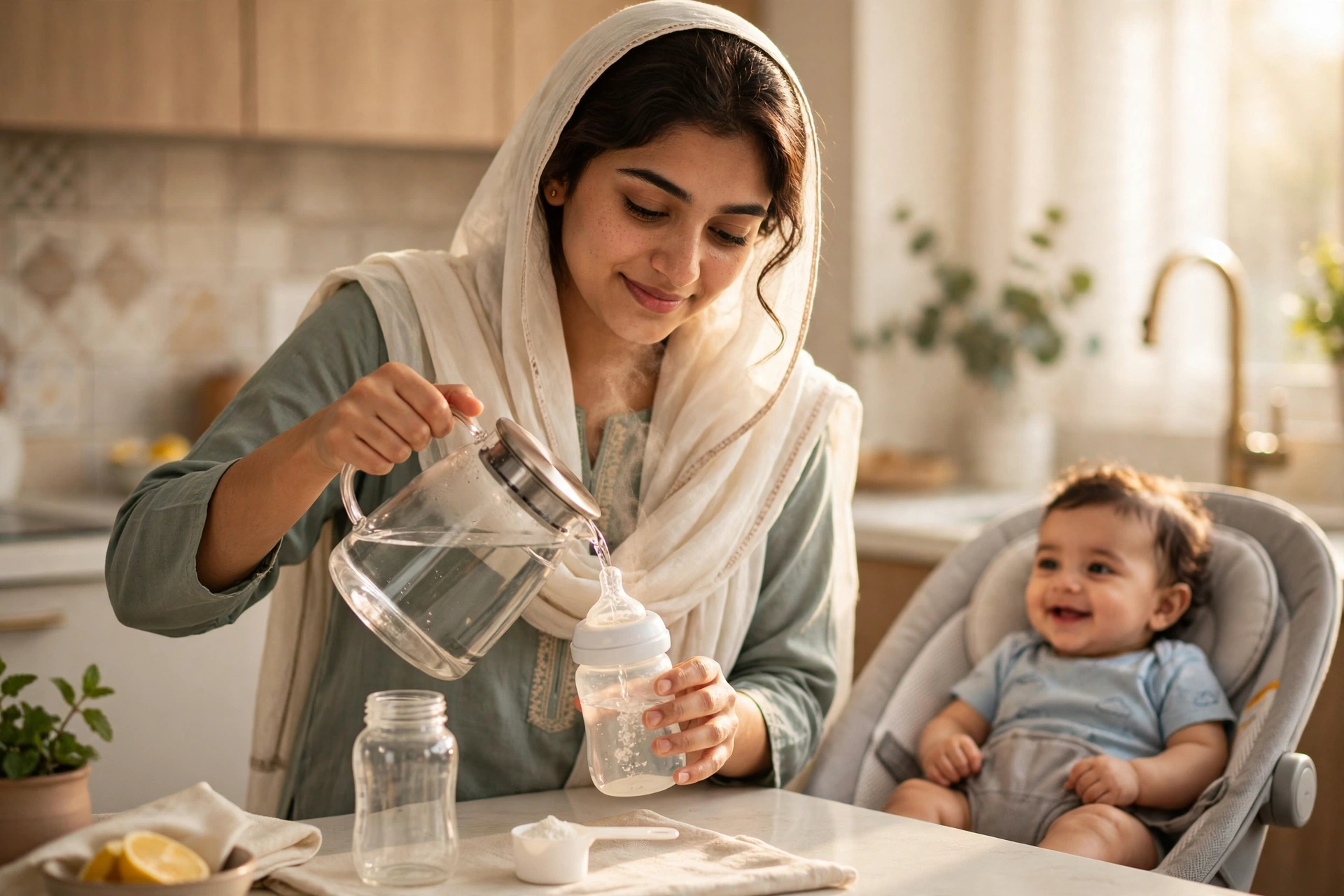
Preparing a bottle of formula looks simple — water, powder, shake, feed — but each step matters. Powdered infant formula is not sterile, so it can carry tiny amounts of bacteria even in a sealed tin. A careful routine removes almost all of that risk.
Breast milk is best for babies, and formula should be used on a health professional’s advice. This guide follows the World Health Organization (WHO) method, with practical notes for Pakistani homes.
Why the 70°C rule matters
The WHO recommends preparing powdered formula with water that is no cooler than 70°C — hot enough to kill most harmful bacteria that can occasionally be present in powdered formula, including Cronobacter, which is especially dangerous for newborns and premature babies.
Many parents get this wrong with the best intentions: lukewarm water feels safer for a baby’s mouth, but it does not kill those bacteria. Make the feed hot, then cool it to feeding temperature before giving it to your baby. Never prepare formula for the whole day in advance, and never top up an unfinished bottle later.
Before you start
Wash your hands with soap and water and dry them on a clean towel. Wipe the preparation surface clean. Check the tin: it should be within its expiry date, the lid should close properly, and the powder should look dry and free-flowing — if it is damp, clumped, or smells unusual, do not use it. Always follow the scoop directions printed on your own tin; they take precedence over any general guide, including this one.
Step 1: Boil fresh water
Bring fresh drinking water to a rolling boil. In Pakistan, do not use untreated tap water for formula, even if your household drinks it; if your supply comes from a tank or a source you are unsure about, start with filtered or bottled drinking water and still boil it. Never re-boil water left standing, or use water from a kettle that has been sitting for hours.
Step 2: Cool to no less than 70°C — use it within 30 minutes
After boiling, let the water cool — but not too much. It must still be at least 70°C when you mix in the powder, which means using it within about 30 minutes of boiling; after that, boil a fresh batch rather than guessing. Water cools faster on a cold winter morning and stays hot longer in a flask, so when in doubt, boil fresh.
Step 3: Measure the water first, then add exact level scoops
Pour the measured water into a clean, sterilised bottle first, then add the powder. The standard ratio in Pakistan is one level scoop for every 30 ml of water, unless your tin says otherwise. Use only the scoop that came with the tin, fill it, and level it off with the back of a clean, dry knife — do not heap it or pack it down. Never add extra scoops “to make it stronger” or fewer “to make it last longer”: too-strong formula can strain a baby’s kidneys and cause constipation and dehydration, while too-weak formula does not give your baby the nutrition they need.
If you are unsure how much your baby needs per feed, see our formula feeding chart by age.
Step 4: Mix, then cool to feeding temperature
Put the sterilised teat and cap on the bottle and shake well until all the powder has dissolved, with no lumps at the bottom. Then cool the bottle quickly to feeding temperature (around body temperature, about 37°C) by holding it under cold running water or standing it in a bowl of cold water, keeping the teat covered so no tap water gets in. Before feeding, test the temperature yourself: shake a few drops onto the inside of your wrist. It should feel warm, not hot. Never warm a bottle in the microwave — microwaves heat unevenly and can create scalding hot spots even when the outside of the bottle feels only warm.
Step 5: Feed promptly, and throw away leftovers
Offer the feed as soon as it is at the right temperature, and remember these safe windows:
- At room temperature: use a prepared feed within 2 hours, then throw it away — even if your baby only took a few sips.
- In the fridge: if you must prepare a feed in advance, cool it quickly, refrigerate it immediately at 5°C or below, and use it within 24 hours. Reheat it only once, by standing the bottle in warm water — never in the microwave — and throw away anything left after the feed.
- A feed your baby has drunk from: never save, reheat, or offer it again later. Once a baby’s mouth has touched the teat, bacteria from their mouth are in the milk and multiply quickly.
Do not prepare a batch of bottles for the whole day in the morning — fresh per feed is safest.
Sterilising bottles, teats, and equipment
Until your baby is at least 12 months old, sterilise all feeding equipment — bottles, teats, caps, rings, and the scoop — before every use. Most families sterilise a day’s set in one go and keep them assembled and covered until needed.
First wash everything in hot, soapy water after a feed, using a bottle brush, then rinse well — sterilising only works on clean equipment. Then sterilise with a steam steriliser or a cold-water sterilising solution, following its instructions exactly; boiling equipment in a covered pot for at least 10 minutes is a traditional alternative. Store items assembled with the teat covered, without touching the inside of a teat or a bottle rim. Replace cracked, torn, or sticky teats, and keep cold-water sterilising tablets as a backup for power cuts.
Pakistan-specific situations
Load-shedding. If a power cut interrupts a steriliser mid-cycle, re-run it once power returns. A fridge off for several hours may have risen above 5°C — if unsure how long the power was out, discard refrigerated feeds and make a fresh one. Keep a flask of freshly boiled water ready during announced load-shedding hours.
Summer heat. In hot weather the 2-hour limit matters even more: a bottle left in a warm room, a car, or sun warms up fast. Carry prepared feeds in an insulated bag with an ice pack, still discard them after 2 hours, and never leave a made-up bottle in a parked car.
Travelling. Carry sterilised empty bottles, the tin with its scoop, and a flask of water kept hot (above 70°C). Make the feed fresh when needed, cool it under a tap or in cold water, and test it on your wrist. Pre-made feeds carried for hours in a warm bag are the riskiest option.
Water quality. For tanker water, a roof tank, or interrupted supplies, do not rely on boiling alone to fix visibly dirty or foul-smelling water — start with trusted filtered or bottled water, and still boil it fresh.
Common mistakes to avoid
Lukewarm water: water must be at least 70°C when the powder goes in. Cool it after mixing, not before. Powder before water, or guessing amounts: water first, measured; powder second, level scoops. Reheating leftovers: a half-finished bottle is finished — reheating does not make it safe. Microwaving: uneven heating and hot spots make microwaves unsafe for warming formula, even for a few seconds. Skipping sterilisation “just this once”: for babies under 12 months, every bottle, every time.
To see the stages laid out side by side, you can compare formula stages by age before discussing the right stage with your pediatrician.
Frequently asked questions
Formula bananay ke liye pani kitna garam hona chahiye?
Pani ubalnay ke baad itna thanda karein ke woh 70°C se kam na ho — aam tor par ubalnay ke 30 minute ke andar istemal karein. Powder isi garam pani mein daalein, phir bottle ko thanday pani mein rakh kar feeding temperature tak thanda karein aur kalai par test karein.
Tayyar formula kitni der tak rakh sakte hain?
Kamray ke darja hararat par tayyar feed sirf 2 ghantay tak istemal karein, is ke baad phaink dein. Fridge mein rakhi feed 24 ghantay ke andar istemal kar lein. Bachay ke munh se laga hua bacha hua doodh kabhi dobara istemal na karein.
Can I use a microwave to warm my baby’s bottle?
No. Microwaves heat unevenly and can leave scalding hot spots even when the bottle feels only warm outside. Stand it in a bowl of warm water instead, shake well, and test a few drops on your wrist first.
Do I really need to sterilise bottles every time?
Yes, until your baby is at least 12 months old. Washing alone is not enough, because powdered formula is not sterile. Wash first, then sterilise, and store bottles assembled with the teat covered.
What if I run out of boiled water at night?
Keep a flask of freshly boiled water by your bed, and sterilised bottles ready. If the flask water has sat for many hours and may no longer be above 70°C, boil a fresh kettle rather than risking it.
This article is general information only and is not medical advice. Feeding practices vary from baby to baby, and nothing here replaces the guidance of your own doctor. Please consult your pediatrician about your baby’s feeding, growth, or health at any time you are unsure — especially in the first six months.