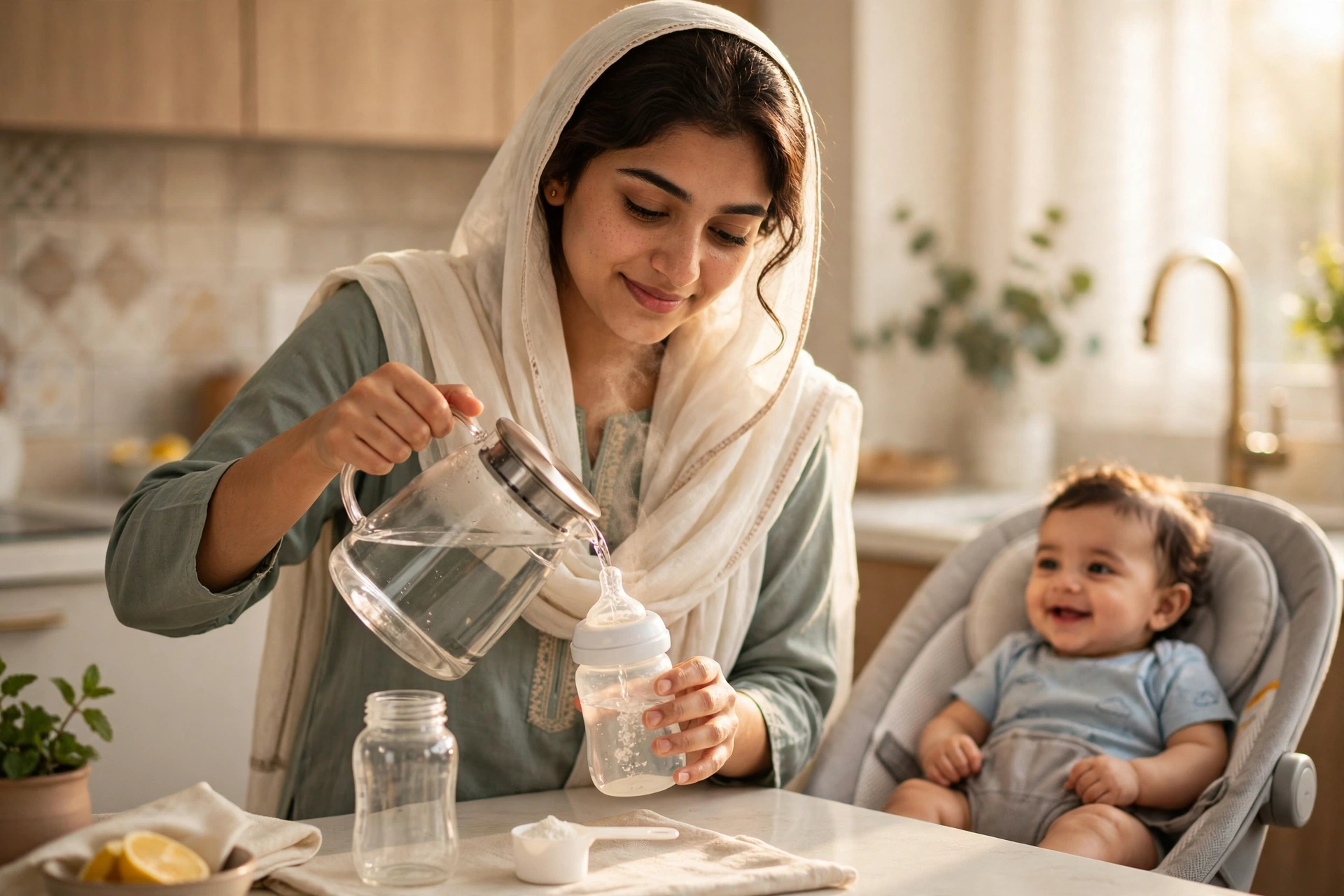

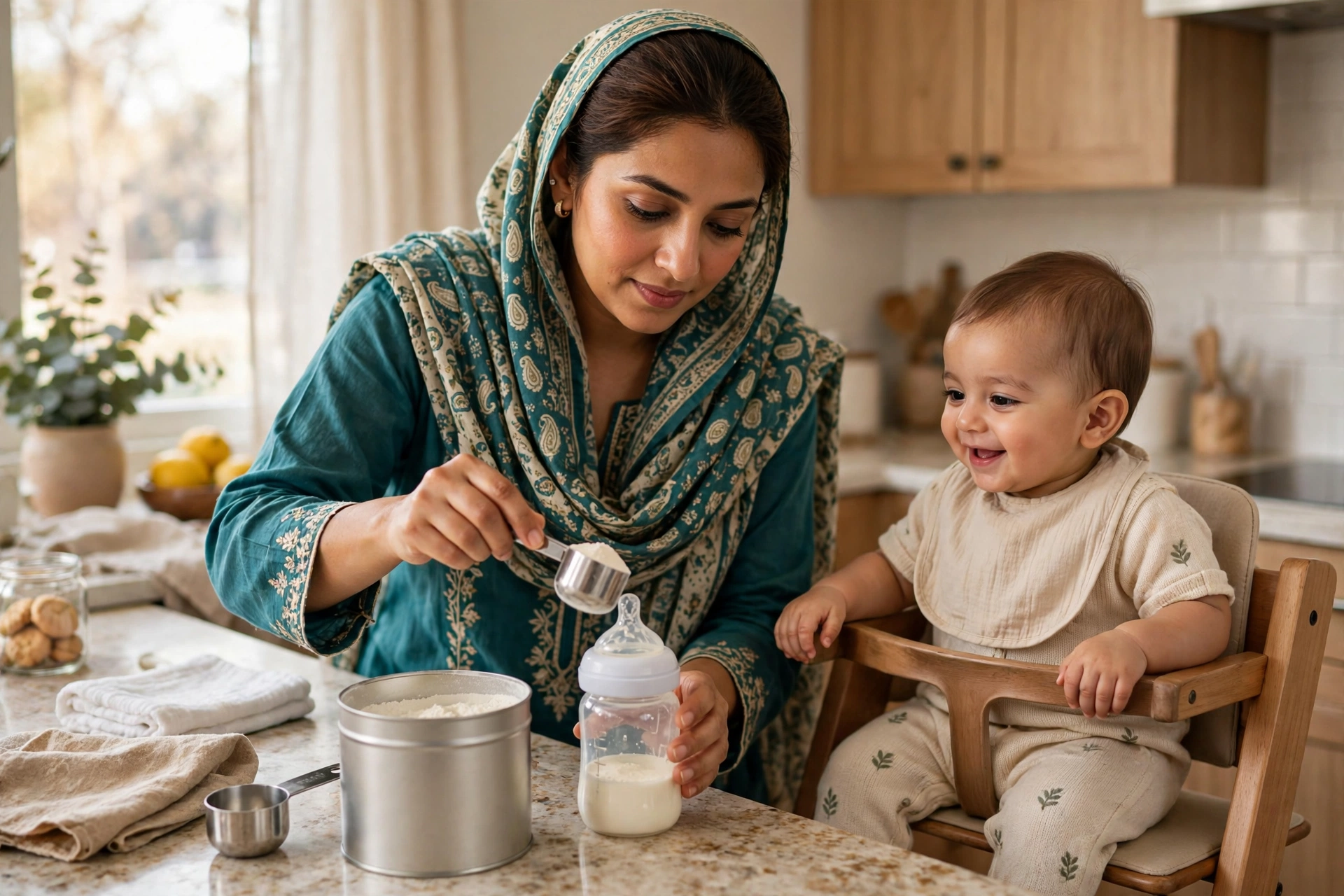
Once you open a tin, how many days will it actually last? It depends on two things — how much milk your baby drinks each day, and how big the tin is.
Breast milk is best for babies, and formula should be used on a health professional’s advice. This guide works out the numbers, so you can plan ahead and know when an opened tin should be finished.
The simple maths behind a tin
Every formula tin works on the same basic rule: one level scoop of powder for every 30 ml of water, unless your tin says otherwise. So a tin’s life is really a question of how many scoops it holds and how many scoops your baby uses in a day.
A standard 400 g tin holds roughly 90 scoops, which makes about 2.7 litres of prepared formula. A smaller 200 g pack holds roughly half that — about 45 scoops, or around 1.35 litres. Scoop sizes vary a little between brands, so the exact number of feeds is printed on your own tin’s label.
How many days does a tin last at each age?
The table uses the daily amounts from our formula feeding chart by age and the approximate 2.7-litre yield of a 400 g tin. Every baby is different, so treat these as a guide, not a promise.
| Age | Typical total per day | 400 g tin lasts about | 200 g pack lasts about |
|---|---|---|---|
| 0–2 weeks | 240–540 ml | 5–7 days | 2–4 days |
| 2 weeks–2 months | 540–900 ml | 3–5 days | 2 days |
| 2–4 months | 720–1,000 ml | 3 days | 1–2 days |
| 4–6 months | 750–1,080 ml | 3 days | 1–2 days |
| 6–9 months | 720–950 ml, plus solids | 3–4 days | 2 days |
| 9–12 months | 540–800 ml, plus family foods | 3–5 days | 2–3 days |
Two patterns stand out. A tin lasts longest in the very first weeks, when feeds are tiny, and again after nine months, when family foods start to replace some milk. The middle months — roughly two to six months — are when a tin disappears fastest, because your baby is drinking the most milk per day and solids have not started yet.
Work it out for your own baby
Three steps give you your own answer:
- Add up one day’s formula. For one normal day, note how much prepared formula your baby drinks — add up the millilitres in every bottle.
- Check your tin’s yield. Look on the label for how much prepared formula the tin makes. If it does not say, use the rough guide above: about 2.7 litres for a 400 g tin, about 1.35 litres for a 200 g pack.
- Divide. Tin yield divided by one day’s amount equals the number of days the tin will last — for example, 2,700 ml divided by 900 ml a day is 3 days.
Redo the sum every month or so — your baby’s appetite changes quickly. If your baby is combination feeding, count only the formula feeds.
The one-month rule for an opened tin
Here is the rule many parents miss: an opened tin of powdered formula should be used within four weeks (one month) of opening, even if powder is still left inside. After that, the powder is no longer considered fresh enough to use, and the tin should be discarded.
This matters most when your baby takes only one or two formula bottles a day — for example, when combination feeding. A tin can easily sit open for longer than a month, so the smaller 200 g pack is usually the better fit.
Write the opening date on the tin with a marker when you first open it — it removes all guessing later.
How long does an unopened tin last?
An unopened tin lasts until the expiry date printed on the base or the lid — usually many months from when you buy it. Two sensible habits cover it: check the date before you buy (a tin bought today should have months of life left on it), and use the oldest tin first if you have more than one at home.
Store unopened tins in a cool, dry cupboard away from direct sunlight — in a Pakistani summer, a tin left near a stove or in a hot car will not keep as well.
Keeping an opened tin fresh
Once a tin is open, four habits keep the powder good for the full month: always use a dry scoop (a wet scoop makes powder clump and spoil faster — dry it fully before it goes back in); close the lid after every feed (an open tin absorbs humidity from the air); keep the tin in a cool, dry place (do not store opened formula in the fridge — the moisture when you take it in and out can cause clumping); and do not move powder to another container unless it is clean, dry, and airtight.
If the powder ever looks clumped, smells unusual, or has changed colour, do not use it. When in doubt, ask your pediatrician.
How to make a tin last safely
A tin sometimes runs out faster than expected, and the temptation is to stretch it. Two shortcuts are common — and both are unsafe:
- Never water down a feed to make the tin last longer. Adding extra water means your baby gets less nutrition in every bottle, and it can disturb the balance of salts and water in a small baby’s body. Always follow the tin’s scoop-to-water ratio exactly. Our step-by-step guide explains how to prepare formula milk safely, including the 70°C water method and the exact scoop rule.
- Never add extra scoops to “make it stronger”. More powder does not mean more nutrition — it makes the feed too concentrated, which can strain your baby’s kidneys.
The safe way to make a tin last is simply to plan ahead. When a tin is about two days from empty, get a replacement, so you are never caught short at night. Keep one spare unopened tin at home if your baby is fully formula fed — it keeps until its expiry date, so a spare is not wasted.
When a tin seems to run out too fast
If a tin is disappearing much faster than the table suggests, check three things before worrying. First, is the scoop level? A heaped scoop uses more powder than a level one — level every scoop with the flat edge of a clean knife or the leveller in the tin. Second, are feeds being thrown away? Prepared formula must be used within two hours at room temperature, or within 24 hours in the fridge — after that it must be discarded. Try a slightly smaller bottle and top up only if your baby is still hungry. Third, has your baby hit a growth spurt? Babies go through short phases of drinking noticeably more, usually for a few days. If the increase lasts longer than a week, or your baby seems unwell, speak to your pediatrician.
Reading the label: what affects tin life
Two numbers on the label shape how long your tin lasts: the scoop size — one level scoop per 30 ml of water is standard in Pakistan, but always follow your own tin — and the number of feeds the tin makes. Labels also carry the nutrients inside the formula, including DHA and ARA, which support your baby’s brain and eye development. The amounts on the label assume the correct scoop ratio, which is one more reason to measure carefully. You can see which formulas are available and their stage information on our products information page.
The simple version
A 400 g tin makes roughly 2.7 litres of prepared formula, which lasts about three days for most babies between two and six months, longer for newborns and for babies over nine months who are also eating family foods. An opened tin should be finished within one month, whatever is left inside. Mark the opening date, keep the scoop dry, and never water down a feed to stretch a tin.
Roman Urdu FAQs
400g ka dabba kitne din chalta hai?
Aksar bachon ke liye 2 se 6 mahine ki umar mein ek 400g ka dabba taqreeban 3 din chalta hai. Naye paida honay walay bachay ke liye 5 se 7 din, aur 9 mahine ke baad 3 se 5 din tak chal sakta hai.
Khula hua dabba kitne arsay tak istemal kar sakte hain?
Khula hua dabba kholnay ke din se 4 hafton (1 mahine) ke andar khatam kar lena chahiye, chahe andar powder bacha ho. Dabba kholtay hi us par tareekh likh dein.
Dabba jaldi khatam ho raha ho to kya karun?
Pehle scoop check karen — bhar bhar ke scoop se powder zyada kharch hota hai, hamesha level scoop istemal karen. Doodh mein zyada pani mila kar dabba lambha karne ki koshish kabhi na karen. Agar bhook barh gayi hai to shayad growth spurt hai; agar aik haftay se zyada rahe to pediatrician se poochain.
This article is general information only and is not medical advice. Breast milk is best for babies; use formula on a health professional’s advice. If you have questions about your baby’s feeding, growth, or development, please speak to your pediatrician.