
Around six months, most babies are ready for their first tastes of solid food. In Pakistani homes this is a happy milestone — the first spoonful of soft khichri, a little mashed banana, a taste of plain dahi. It also brings questions: what should the first food be, and does starting solids mean milk feeds stop?
Starting solids at 6 months is a beginning, not a replacement. Milk stays your baby’s main food until their first birthday; solids start as small tastes alongside it and slowly grow into real meals.
Breast milk is best for babies, and formula should be used on a health professional’s advice. This guide covers the readiness signs, the Pakistani first foods that work well, how to offer them, and what to wait on.
Signs your baby is ready
Most babies are ready at around six months, not before four months. Look for these signs together:
- Sitting up with support — your baby can sit in a high chair or on your lap and hold their head steady.
- Good head control — they can hold their head up and turn it towards food, or away when they have had enough.
- The tongue-thrust reflex has faded — younger babies push food straight back out with their tongue; when this fades, they can move food back and swallow.
- Interest in food — they watch you eat, reach for your plate, or open their mouth when food comes near.
Every baby is different, and a few weeks either side is normal. If your baby was born early, go by their corrected age and ask your pediatrician.
How to start: the first spoonfuls
Start slowly — one new food at a time, in a small amount, once a day.
- One food, two or three days. Offer one new food and wait two or three days before the next. If your baby reacts to something, you will know which food it was.
- Start with one or two teaspoons. A first serving is tiny. Do not worry if most of it ends up on the chin or the bib.
- Offer solids after a milk feed, not instead of one. A baby who has had some milk first is patient enough to practise with a slow spoon.
- Pick a calm moment. Mid-morning often works well. Keep the first tries short and stop when your baby turns away or closes their mouth.
Expect mess — eating is a new skill, and your baby will smear, drop, and spit food out while learning. After a week or two of single tastes, build up to two small meals a day, then three by around eight or nine months. Let your baby’s appetite lead.
Pakistani first foods that work well
You do not need imported baby food. The foods already cooked in a Pakistani kitchen, made soft and plain, are excellent first foods.
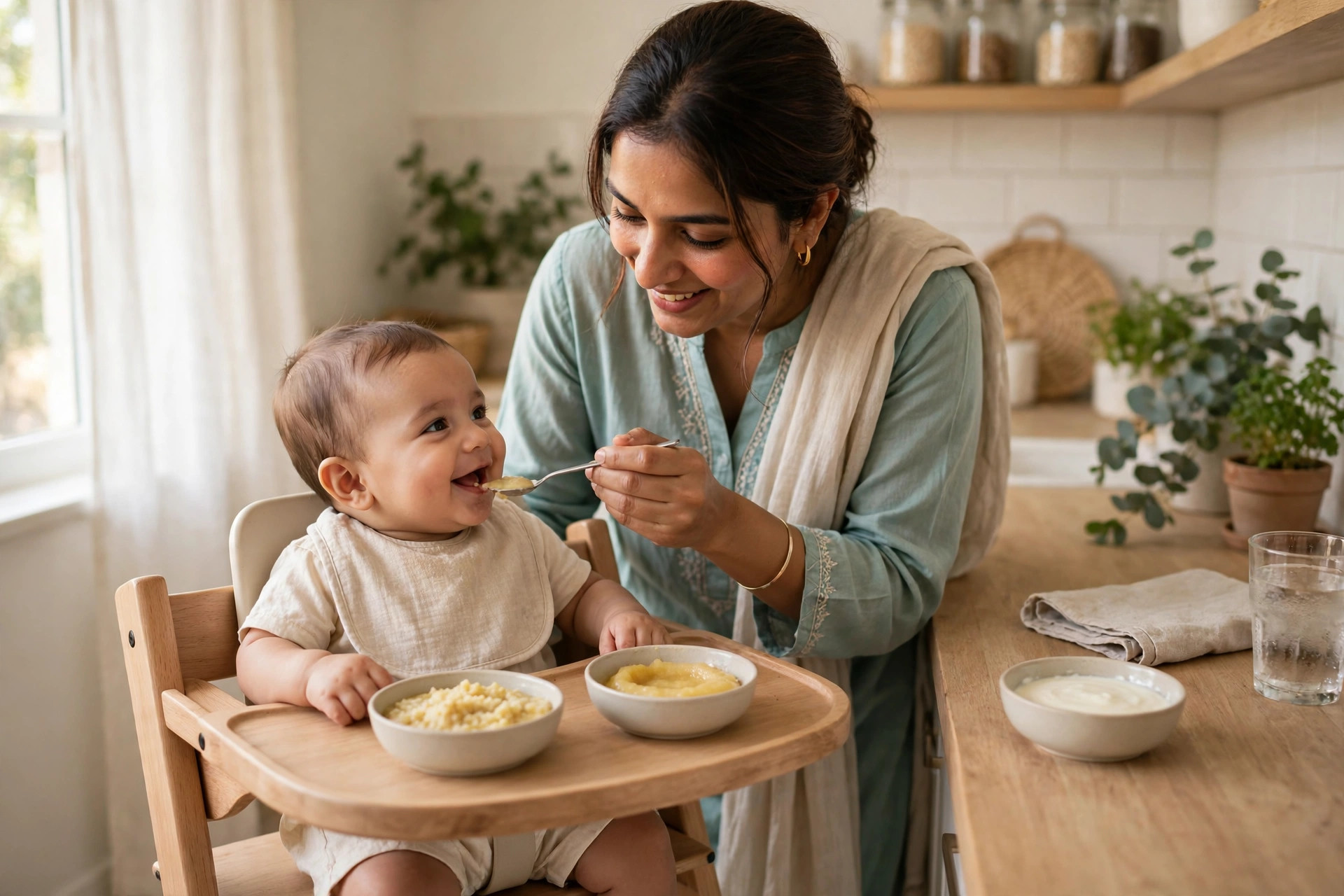
Khichri — the classic first food. Soft, well-cooked khichri from moong daal and rice is gentle, easy to swallow, and filling. Cook it softer than the family’s khichri, mash it smooth, and serve it plain — no salt, no chilli, no ghee tarka. A spoonful of plain yoghurt stirred in makes it creamier.
Daliya — soft wheat porridge. Daliya, cooked very soft in water and mashed smooth, is another easy first food — cook it thin at first, then thicker as your baby gets used to it. A little mashed banana stirred in adds sweetness without added sugar.
Mashed banana (kela). A ripe banana mashed with a fork is one of the simplest first foods — naturally soft, naturally sweet, and needing no cooking. It is easy to carry when you are out, and most babies accept it quickly.
Plain yoghurt (dahi). Plain, unsweetened dahi at room temperature is a good early food, on its own or mixed into khichri or daliya. Use plain dahi, not flavoured or sweetened yoghurt.
Soft daal and vegetables. Well-cooked, mashed moong or masoor daal, or soft mashed pumpkin (kaddu), carrot (gajar) or peas (matar), are good once your baby has had a few first tastes. Daal also helps with iron, which becomes important from around six months.
Keep every first food plain: no added salt, no added sugar, no chillies or strong spices — season the grown-ups’ portions, not the baby’s.
From smooth to lumpy
First foods should be smooth — a texture that drips slowly off the spoon. Make food gradually thicker and lumpier over the next few months: smooth purees at six months, thicker mashes with soft lumps at seven to eight months, and soft finger foods — a piece of soft banana, a strip of well-cooked sweet potato — by eight or nine months.
Gagging is common when textures change. It is different from choking: a gagging baby makes noise and coughs and usually clears the food themselves, while a choking baby is silent and cannot breathe. Always stay with your baby while they eat.
What milk still does
Starting solids does not mean milk feeds stop. Until twelve months, breast milk or formula is still your baby’s main source of nutrition. Solids are for learning tastes and textures — they add to milk, they do not replace it.
Keep offering milk feeds at the usual times, and offer solids in between. Our formula feeding chart by age shows how milk amounts change as your baby grows. Water can be offered in small sips with meals from six months. There is no need for juice at this age.
Foods to wait on or avoid
- Honey — not before twelve months. Honey can carry a rare but serious risk for babies under one year, so avoid it completely, including in cooked foods.
- Salt and sugar. A baby’s kidneys are still developing, and they do not need added salt or sugar.
- Cow’s milk as a main drink — not before twelve months. Small amounts in cooking are usually fine, but it should not replace breast milk or formula. If unsure, ask your pediatrician.
- Whole nuts, whole grapes, popcorn and hard sweets. These are choking hazards. Nuts can be offered as a smooth paste once your baby is older — never whole.
- Very spicy food and chai. Chillies and strong spices are too much for a young baby, and tea has no place in a baby’s diet.
- Unpasteurised milk and undercooked meat or eggs. Everything your baby eats should be fully cooked.
If food allergy runs in your family, ask your pediatrician about introducing foods like egg, peanut, or fish.
A simple first week
Treat this as an example, not a rule — any order of plain first foods works. Days one and two: a teaspoon or two of mashed banana, once a day, after a milk feed. Days three and four: soft, smooth khichri. Days five and six: daliya, cooked soft and thin. Day seven: plain dahi, or whichever food your baby liked most, offered again.
In week two, keep the foods your baby accepted and add a new one every two or three days. By the end of the first month, most babies are having two small meals a day — and still taking their usual milk feeds.
Common worries
“My baby pushes all the food out.” That is usually the tongue-thrust reflex, which fades with practice. Try again in a few days; if it keeps happening for weeks, speak to your pediatrician.
“My baby only eats a tiny amount.” At six months, a teaspoon or two is a real meal. Appetite builds slowly, and milk is still doing the main job of feeding your baby.
“My baby gags on lumps.” Gagging is how babies learn to manage food in their mouth. Go back to a smoother texture for a few days, then try lumps again. If gagging is frequent, ask your pediatrician.
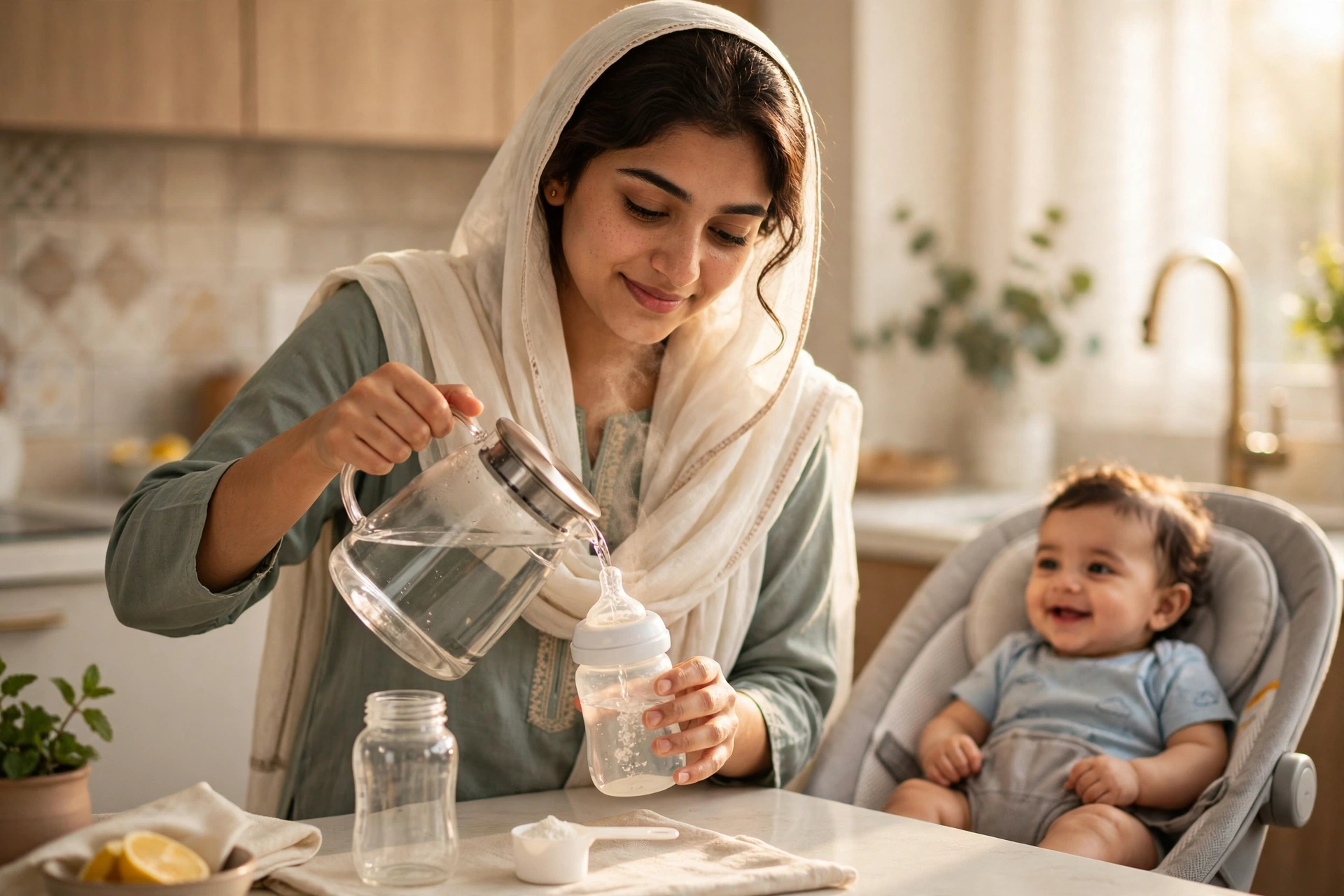
“Should I stop formula now that solids have started?” No. Formula, like breast milk, remains the main milk until twelve months. Our guide on how to prepare formula milk safely explains the feeding and storage basics.
The simple version
Wait for the readiness signs at around six months: sitting with support, steady head control, interest in food, and the tongue-thrust reflex fading. Start with one plain food at a time — khichri, daliya, mashed banana, or plain dahi — a teaspoon or two, once a day, after a milk feed. Make it thicker and lumpier over the following months, and keep everything plain: no salt, no sugar, no honey before twelve months, no cow’s milk as a main drink. Milk stays the main food until twelve months. You can find which formulas and stages are available on our products information page.
Roman Urdu FAQs
Bachay ko solids kab se shuru karna chahiye?
Aksar bachay 6 mahine ki umar mein solids ke liye tayyar hotay hain — sahara le kar baithna, sar sambhalna aur khane mein dilchaspi is ki nishaniyan hain. Har bachay ka apna waqt hota hai.
Pehli dafa konsi ghiza deni chahiye?
Narm khichri, daliya, masla hua kela ya saada dahi — ye sab behtareen pehli ghizayen hain. Ek waqt mein ek hi nayi ghiza dein, aur 2–3 din baad doosri shuru karen. Pehle chand chamach hi kaafi hain.
Kya solids shuru honay ke baad doodh band kar dena chahiye?
Nahi. 12 mahine tak doodh — chahe maa ka doodh ho ya formula — bachay ki bunyadi ghiza rehta hai. Solids is ke saath seekhnay aur chakhne ke liye hain, is ki jagah lene ke liye nahi.
This article is general information only and is not medical advice. Breast milk is best for babies; use formula on a health professional’s advice. If you have questions about your baby’s feeding, growth, or development, please speak to your pediatrician.